Ceramic Vases & Candleholders for Home Decor Programs: A Wholesale Buying Guide
Buy vases and candleholders as a small family of shapes in one palette, not as single pieces picked at random. Check the opening, the base and the finish on a physical sample, and confirm the packing per item before you order. This guide is for importers and wholesalers building a year-round home decor program: the everyday lines that sell between the Christmas and Easter peaks. It is not for one-off retail gifts, and it is not a tableware guide: tableware carries different duty treatment in the EU and is confirmed separately.
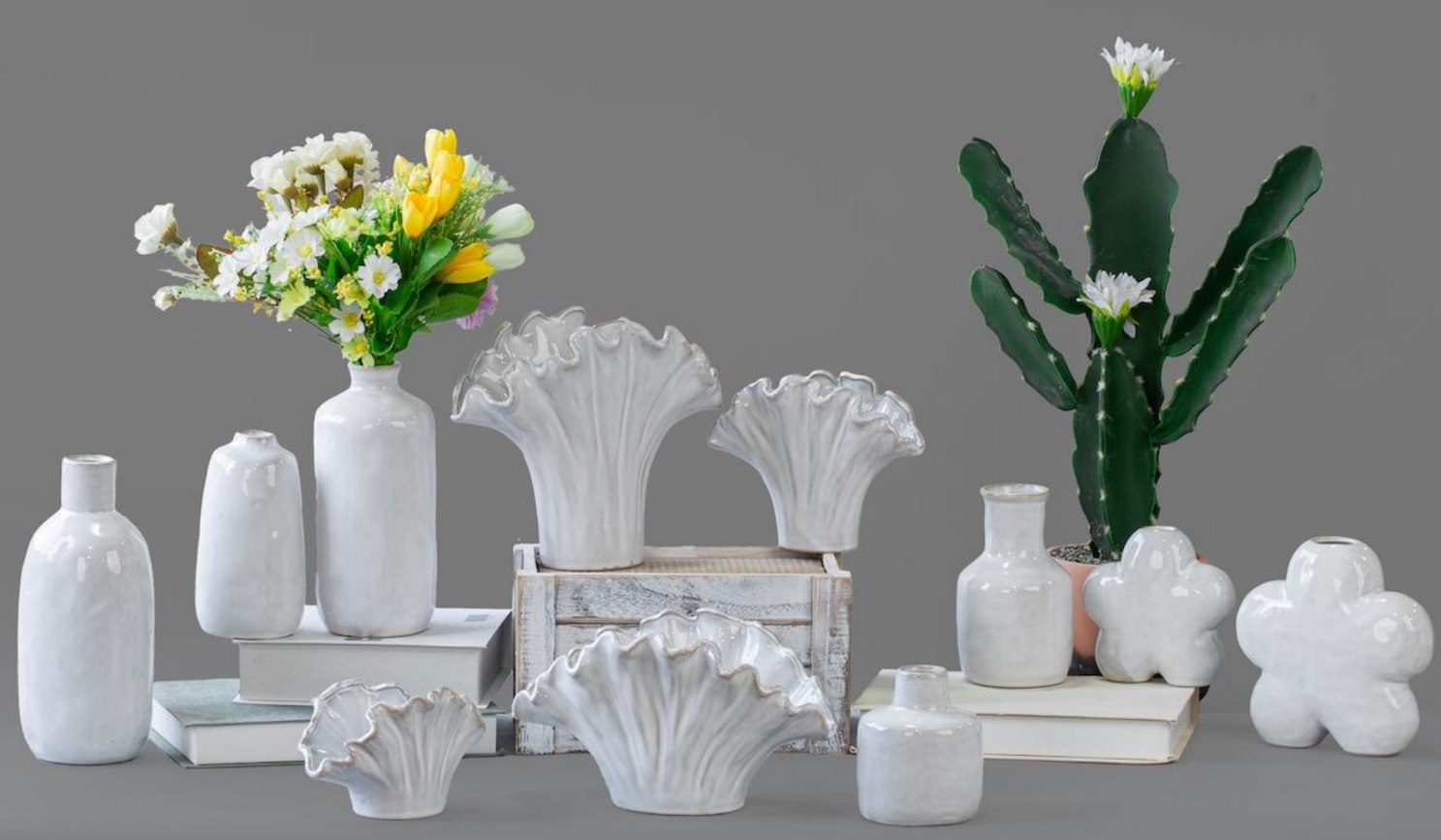
Why do vases and candleholders earn a place in every home decor program?
Seasonal ceramics sell in waves: a Christmas range peaks, then it is gone. Vases and candleholders do not work that way. A vase sells in January and in July, with fresh flowers in spring and dried stems in autumn, and a candleholder sells whenever the evenings get dark. That steadiness is why buyers keep them in the range.
They also sell in sets. A customer who buys one vase often comes back for the matching smaller one, and a candleholder in the same glaze reads as a collection rather than two separate purchases. A small number of well-chosen styles can do the work of a much larger range. Our guide to building a seasonal ceramic assortment explains how these evergreen lines sit alongside the seasonal peaks.
Why do vase and candleholder programs go wrong?
Most problems with these pieces are small, physical and entirely avoidable.
The wrong size for the shelf. A vase too tall for the display, or too narrow to hold a stem without tipping, is a return waiting to happen. Ask for the height, the opening width and the base diameter before you approve a style.
Glaze and colour drift across a set. Two vases in the same glaze, fired in different batches, can read as two different colours on a shelf, and hand-painted detail varies slightly from piece to piece. Check the colour on the physical sample, in daylight and under shop lighting, and agree what counts as acceptable variation before production starts.
A piece that cannot do its job. A vase that is not watertight is a decoration, not a vase, and a candleholder that does not fit the candle it is sold with is a complaint. Confirm per item whether the vase holds water and which candle size the holder takes.
Breakage in transit. Vases and candleholders are hollow, thin-walled and top-heavy, which makes them the first things to break in a badly packed carton. Packing is confirmed per item, so ask how a tall vase is protected inside its box before you order it.
Which shapes and sizes actually sell?
Buy a family, not a list. The pattern that works best is three sizes of one shape: a tall vase, a medium one and a small bud vase, all in the same glaze. They merchandise as a set, and a shop can sell them together or separately. The same logic works for candleholders: a tall taper holder, a tealight holder and a small votive in one palette.
Shape matters more than novelty. The shapes that sell year after year are simple and recognisable: a clean cylinder, a gentle amphora, a bud vase with a narrow neck. Sculptural shapes are the novelty line — one or two statement pieces per range — while the simple shapes carry the volume. If a shape only works in one room or one season, it is a novelty piece; if it works on a dining table, a mantelpiece and a shop window, it is a volume line.
Size is a merchandising decision. Small and medium pieces suit gift shops and online sellers, where a piece has to survive a courier and fit a gift box. Taller pieces suit garden centres and home stores with floor displays. Decide where the piece will be sold before you pick the size.
Our home decor collection carries the vase and candleholder range, with porcelain styles in porcelain decor and planters and garden-adjacent pieces in green decor — pieces that pair naturally with vases on the same shelf.
Glaze, matte or hand-painted: which finish fits your range?
The finish is what the customer sees first.
Glazed ceramic is the workhorse: a smooth, even colour, easy to match across a set, and the most forgiving finish for repeat orders. If your range needs the same cream vase in March and in September, a glazed finish is the safest choice.
Matte finishes read softer and more modern, and suit the muted palettes — white, sage, soft grey — that many home decor buyers ask for now. Matte shows fingerprints and dust more readily than gloss, so check a matte sample in hand before committing a whole range to it.
Hand-painted detail is what makes a piece feel made rather than manufactured. It varies slightly from piece to piece, so it fits best where the customer expects craft: gift shops, garden centres and independent home stores. For a buyer who needs every piece identical, a glazed finish is the better call.
One rule covers all three: never approve a colour from a screen photo. Screens lie about colour. The physical sample is the only reliable reference.
What should you check on a sample before you order?
Check these points on the piece itself, not on a photo:
- Dimensions, measured in hand. Height, opening width, base diameter, weight. Does it stand steady, and hold a stem without tipping?
- Water and candle fit. Does the vase hold water without seeping? Does the candleholder take the candle size you sell — taper, tealight or pillar — and sit stable with it lit?
- Colour and finish, in two lights. Daylight and shop lighting. Compare two pieces of the same style: is the variation acceptable for your shelf?
- Glaze and decoration, up close. Pinholes, rough patches, uneven hand-painting, decal edges lifting. Run a finger over the rim and the base.
- Packing, as it will ship. How is the piece wrapped and boxed? A tall vase needs more protection than a small votive.
- The style list, in writing. Exactly which styles are being sampled, and what the sample fee covers. Sampling usually takes around 10–15 days once the sample fee is received, but confirm the date per program, and ask whether the fee is deducted from the first order. How pieces are checked before shipment is on our quality-control page.
A supplier who answers these questions clearly, in writing, before asking for a fee has checked with production. One who cannot answer them has not.
What to send us to start
Topreal Crafts is a ceramic manufacturer and exporter based in Xiamen. Our home decor range covers vases, candleholders, planters and small decorative pieces alongside our seasonal Christmas, Easter, Halloween and Harvest ceramics, with specifications confirmed item by item.
To start, send us your marked catalogue pages, or the shapes and sizes you have in mind, with the quantity you have in mind per style, via our contact page. In return, you get item-by-item confirmation on exactly those styles, and Lisa replies within one business day.
Have a collection in mind?
Share a product reference, a category you are sourcing, or the occasion you are planning for. Lisa is ready to help with your collection inquiry.
Xiamen Topreal Crafts Co., Ltd.
Tel / WeChat / WhatsApp: +86 131 9407 9226
No.704, Building 21, Qiaowenli, Siming District, Xiamen, China
www.toprealcrafts.com ↗